

An incorrectly set up or unsuitable design of subwoofer can seriously compromise the accuracy of your monitoring environment. We outline the performance characteristics of the different types and show you how to incorporate a sub for optimum effect within your system.
 In this article, I intend to look in detail at the way subwoofers should be used in the studio, and how you can go about choosing and configuring the necessary components. Installed and used correctly, systems incorporating subwoofers can perform extremely well, with the 'sub' being acoustically invisible. However, to many people involved in audio production, having a subwoofer implies having too much low end, or bass which is flabby and ill-defined.
Whatever your feelings, subwoofers are now an inescapable part of the audio reproduction chain, especially now that domestic multi-channel audio equipment is available for consumer DVD Video playback. The benefits of using smaller main speakers in conjunction with a subwoofer are, in theory at least, many and varied. This type of monitoring system can be an ideal solution in many situations where the size and weight of full-range monitors can be problematic, as is often the case in small mix rooms. There is also the advantage that sub and satellite systems usually give better imaging, due to the smaller monitors, and less mid-band intermodulation distortion, due to the lighter bass workload placed on the satellites. Unfortunately, the potential advantages are often not fully realised in practice.
When talking to recordists about subs, a common catalogue of dislikes usually emerges. People will often complain about lack of integration, lumpy or 'honky' bottom end, single-note bass, poor timing and lack of bass headroom. All of these complaints, and indeed many others, are valid and can easily be heard in poorly specified and configured systems. In many cases, a small misalignment or placement error renders an otherwise capable system completely unusable.
What Is A Subwoofer?
 The band-pass speaker construction.The term 'subwoofer' has two common interpretations. The first describes a low-frequency system that takes over below the cutoff of the main speaker's bass unit — I shall refer to this as type A. The second, and perhaps more relevant in the professional audio arena, describes a low-frequency system that takes over below the main speaker's bass frequency limit, and continues down to at least the 20Hz hearing limit and preferably below (a type of signal content commonly referred to as sub-bass although, strictly speaking, signals below 20Hz should be called infra-bass or infra-sound) — I shall call this type B.
 Typical frequency response of a band-pass speaker.The vast majority of the subwoofers currently on sale are type A. This type encompasses the more dubious domestic hi-fi and home cinema units, as well as those found in some car audio applications. The specification for home theatre subs calls for a 30Hz bass response, but this is ignored by many budget manufacturers. Many people believe that a unit capable of extreme Sound Pressure Levels (SPLs) at around 50Hz is a subwoofer. This is not only incorrect, but has also resurrected the series of complaints (such as 'one note bass' and so forth) that started in the early days of ported speaker design.
 It is possible to create a flatter frequency response (lower graph) at the design stage, but this can only be done at the expense of efficiency.It is very easy to understand why this type of unit is commonplace. It is technically straightforward to produce units generating high SPLs above 40Hz or so. It is also easy to generate high levels over very small bandwidths. The real challenge is to produce a unit with high output over a broad bandwidth and in an acceptable size. Due to the laws of physics, this becomes increasingly difficult as frequency falls.
Speakers of type B are available by only a few manufacturers. To generate low-frequency audio at moderate-to-high SPLs, you need to move a lot of air. This requires large-surface-area drivers, large-displacement drivers, high power levels, or a combination of all of these. These factors combine to make true subwoofers one of the more expensive items in the audio chain.
Design Variations
 The reflex speaker construction.The construction of subwoofers will usually follow one of three models, although there are notable exceptions. Each of these is a compromise, with a number of factors which must be juggled to achieve the required results. Designs of type A commonly use reflex or band-pass methods, while type B mainly use reflex or closed-box construction — there are diagrams throughout this article to demonstrate the basic principles of these designs.
Although I do not have space within the framework of this article to examine the technical aspects of these construction types, it is useful to examine the typical response curves generated by them. The most efficient is the band-pass design, which gives the highest SPL for a given amount of input power. These units may be recognised as having one or more ports (holes in the cabinet) that are visible, whilst the driver is not.
 Depending on the tuning of the port, this reflex speaker design is capable of an extended flat frequency response...
 ...or a boosted response over a small band of frequencies.With efficiency comes the small bandwidth and peaky response typical of domestic and car subs. It is possible to smooth out this response at the design stage, at the expense of some efficiency, but even this increased bandwidth cannot match that of other designs. Although this might suggest that the band-pass design would not be an ideal choice for a wide-bandwidth system, it can be used successfully when the main monitors already have a reasonable low-frequency response. Another point to note is that band-pass constructions are quite complex mechanically, and this can make the size, weight and manufacturing costs undesirably high.
The second basic subwoofer model, and perhaps the most common, is the reflex design. It gives reasonably good performance and offers the possibility of greater low bass output when compared with a similar size of closed box. The system is tuned by a port and may be optimised for good extension, as seen in type-B subs, or for greater output over a chosen frequency range, as seen in many type-A units. Reflex designs are easy to spot, as the port and the driver are visible.
 The closed-box speaker construction.
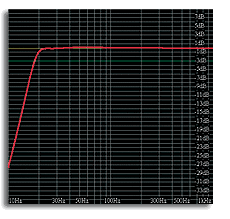
 Typical frequency response of the closed-box speaker.The third fundamental subwoofer design is the closed-box construction. This is the simplest and generates the least low bass output for a given size, but it can also offer the best phase characteristics and group delay (of which more later). In addition, the bass driver is very well controlled due to the air inside the box being trapped. This makes closed-box designs quite rugged and tolerant of out-of-band audio signals.
Various tricks may be applied to closed-box designs to extend the bottom-end frequency response. Used in this way, closed-box designs can be made to perform very well and certainly to type-B standards. In order to achieve a good low-frequency response in a moderate-sized closed box, great demands are placed on the driver unit and amplifier. Typically, drivers used in this application will have very large roll surrounds facilitating big cone excursions. From a cost perspective, the extra performance required from the driver and amplifier will tend to make this method the most expensive. Readers may be interested to know that this type is preferred by the author.
Bass Management
 A block diagram of a simple bass management processor for a stereo speaker system.Unless the user chooses to use a subwoofer with each satellite speaker, rather defeating the object, some form of bass management will be needed. Bass management systems extract the low-frequency elements from each channel and pass the sum of them to the subwoofer. In a simple stereo monitoring setup, this may take the form of a simple crossover with two inputs, one each for left and right, and is normally built into the subwoofer. In a more complex system for multi-channel use, each of the full-range channels requires an input and filter, and an additional input is needed for the dedicated Low Frequency Effect (LFE) channel.
Many of the current domestic amplifiers intended for home cinema applications have good bass management facilities built in, but not all offer bass management when using the multi-channel inputs. If you intend to use such an amplifier in a small studio, it is advisable to check this detail carefully before purchase.
 A block diagram of a simple bass manager for a multi-channel speaker system.The topology of bass management systems varies from manufacturer to manufacturer. It is also fair to say that the effectiveness of these systems also varies. I have found one well-known manufacturer who likes to rely on the natural roll-off of the satellites rather than crossing them over electrically. After much experimentation and measurement, I decided that this method was unreliable — low-frequency roll-off characteristics of satellites vary considerably according to their construction method and placement. Although the system allows the crossover point to be adjusted, no account is made for the slope of the roll-off. This oversight makes it impossible to achieve a flat system frequency response with many satellites. Rather than rely on the natural roll-off of the satellites, I have obtained much more reliable results by imposing a known electrical roll-off a little higher up. In this way, both the slope and the crossover frequency are known quantities.
Subwoofer Headroom
When used in a system with satellites, great demands are made of the subwoofer. For a stereo music system, the sub will need to produce the bass that would normally be generated by two full-range loudspeaker channels. For most moderately proficient sub units this should not represent any real problem, even at higher sound pressure levels, as sensible music mixes will rarely contain peak-level extreme low frequencies.
Consider, though, a multi-channel satellite/sub system. Now the sub has to handle not only the bass elements from five or six channels, but it also has to reproduce the demanding bass content of the LFE channel. Clearly, when such a system is also expected to deliver high SPLs, the subwoofer must be very capable and preferably protected from abuse. All too often subwoofers used in this way will be under-specified, resulting in the sub driver constantly banging it's end stops. This is clearly audible as a loud 'clack' on kick drums or sound effects. The only solution to this problem is to use more or bigger subs.
Phase
To obtain a flat frequency response, the subwoofer and satellites must be in phase at the crossover frequency (the frequency at which the satellites take over from the sub). If this is not the case, the resultant response will have a hump or dip — for example, in the graph on this page you can see the response error from a 43-degree phase shift at 60Hz.
Phase errors originate from a number of sources:
- the phase characteristics of the sub and satellite speakers with frequency.
- the electrical phase characteristics of the crossovers.
- the physical locations of the speakers.
Errors caused by the first two of these factors can be reduced or removed by the use of a variable-phase filter in the subwoofer feed. This usually offers a phase range of zero to 180 degrees. Unfortunately, due to cost considerations, many such filters produce their stated phase adjustment at only one, normally undocumented, frequency. This centre frequency will almost certainly not be that of your chosen crossover point. Some products offer filters with much broader operating bandwidths — in other words the phase adjustment is constant over a broader frequency range — and, in addition, may include a signal invert switch. These give much more flexible and reliable phase compensation.
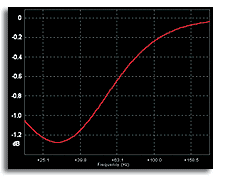 The response anomalies created by a 43-degree phase shift between a subwoofer and its satellites at 60Hz.The third type of phase error can be tricky to remedy. Typically a manufacturer will expect you to use the phase control to correct errors caused by placement difficulties. However, and this is a key point, although this type of difference can be described as a phase error, it is actually a time error. In larger rooms, it is possible to get errors of greater than one complete cycle. Although common phase controls will allow you to align the waveform such that the peaks and troughs coincide, they do not always allow you to align to the same peak and trough. In order to achieve this, a delay line must be inserted in the system, which then begins to make things unwieldy — one reason why the placement of your sub is vitally important.
Placing Your Subwoofer
Many people who have never actually worked with subwoofers say that it doesn't really matter where you put the sub, because low frequencies are omnidirectional. However, this statement is very misleading, because the physical placement of the subwoofer has a huge effect on its frequency response. Also, the interaction between the sub, satellites and listening room will cause peaks and troughs in the frequency and time domains, the effects of which are clearly audible. Can you tell if a speaker is wired out of phase within a few seconds of listening without having your head facing the speakers? Anyone who is 'tuned in' to phase anomalies will 'feel' the same effect from a badly placed sub in a good room.
Conversely, and perhaps this is the root of the aforementioned incorrect advice, the ear cannot detect the physical location of a sub in a sensibly installed system. I was recently demonstrating two subs at a hi-fi show in London. One used a 15-inch driver and the other a 6.5-inch driver. The performance of the systems was such that, when operating within their relative capabilities, the only way to ascertain which unit was in use was to feel the bass driver by hand.
Given that the phase of the subwoofer needs to be matched to that of the satellites, it should be clear that the ideal position for the sub places it at the same distance from the listener as the satellites — this yields the same physical delay for both. Also, as the brain is able to detect the phase errors caused by placing the sub and satellites at different directions relative to the listener, it is reasonable to suggest that the sub is placed in front of the listener along with the satellites. In theory the ideal placement for a stereo system would be centrally between the left and right satellites.
In a multi-channel system there must obviously be a compromise. I would suggest that placement with the front speakers is favoured, as they carry the most important audio information and, once again, a centre position is ideal. However, experimentation shows that any frontal position is workable. The sub should point, or 'fire', directly towards the listener or down towards the floor. If the sub is positioned in a way that allows it to fire across the listening field, audible phase problems may arise.
Placement with respect to walls and other large structural features should be considered next. The majority of smaller subs will be designed so that they can be used out of the way against a wall. If such a unit is used freestanding, the frequency response and output level will suffer. On the other hand, a number of companies produce subs which are designed to be used freestanding and give best results when moved away from walls or other hard surfaces. The rule here is to check with the manufacturer and experiment with placement and/or listening position when performing the system setup.
When choosing a frontal position, care has to be taken if the sub is placed in a corner, as two problems arise. Firstly, corner placement will increase the low bass output of the sub and will often make it boomy. Secondly, using only one subwoofer will encourage the formation of standing waves in the room. This effect is exaggerated with a sub placed in only one corner. The effect of this can be heard as uneven bass throughout the listening room with some areas being boomy and some being bass light. It is possible to minimise this problem by using two subs, along with a shelving filter that curtails the rise in low end — an approach I use in my own listening room.
Group Delay
 A graph of group delay against frequency for a subwoofer, showing a large delay for signals at around 50Hz.Loudspeakers, by their very nature, delay signals at certain frequencies more than at others, and this can affect their performance within a system where phase-matching of the output of different drivers is desirable. Group delay (sometimes also called envelope delay), is the measurement of these frequency-dependent delays, and can be shown plotted on a graph of delay time against frequency — such a graph for a subwoofer is shown here.
Group delay is the least-considered loudspeaker parameter, but it is important, because, in some loudspeaker designs, the delay can be very large (ie. greater than 50ms) in the low-frequency area. If the chosen crossover frequency coincides with a large delay, the placement and phase problems will be impossible to resolve successfully, and a bass manager will be vital in that case. Group delay is normally far larger in satellites with ports than with closed boxes, although the bass response of ported designs is normally better.
Group delay problems can be minimised by following these guidelines.
- Choose satellites designed for low group delay.
- Check the frequency of maximum delay with the manufacturer, and don't use it as the crossover point.
- Set the crossover point at least 10-15Hz higher than the satellite -3dB frequency, if using bass management.
What Crossover Frequency Should I Use?
The crossover frequency between the sub and the satellites will normally be in the region of 40Hz to 90Hz, and will be dictated mainly by the low-frequency performance of the satellites and the group delay at the crossover frequency. To find a good starting point, check the low-frequency response figures given by the manufacturer — if using a bass manager, add 10-15Hz. This crossover point should be adjusted when performing the final setup.
In order to obtain truly seamless integration of the sub, you should choose satellites that go down to at least 70Hz. I have listened to and tested many systems that are designed to cross over at between 100Hz and 250Hz. The results are always disappointing, and these systems tend to sound disjointed and separate and can certainly not, to my ears, be classed as monitor systems or even hi-fi.
Guide To Setting Up Your System
Advising people on the best way to set up a sub/satellite system is a thorny business and one that has led me to exchange heated emails with many 'professional' installers in the past. While, ideally, the setup method should certainly involve detailed measurement using high-resolution test equipment, hardly any end users have access to, or expertise with, this type of gear. By contrast, all audio engineers, amateur or professional, have access to the most detailed measuring equipment yet devised — human ears! Although setting up a system subjectively may not be as accurate in absolute terms, if the system sounds right to the person using it, then it is right. In fact, even if the technical performance of a system seems right, a system which doesn't sound right to the user will encourage them to add bogus equalisation while recording to compensate.
To help those of you who don't have access to the test equipment, here's my subjective adjustment method. First, place the sub and satellites, paying regard to the points raised above. Next, and this is a caveat, choose a recording with a wide-ranging and evenly recorded bass line. I would suggest that classical music is unsuitable for this, as I know of no piece which has a constant and consistent bass content. My business partner once observed that 'modern' music is more suitable for this because it emulates pink noise better! I use Robben Ford & The Blue Line's song 'You Cut Me To The Bone' as a starting point, for judging bass balance. Note that you should beware of most recordings made during the '70s and '80s as, almost without exception, they are bass-light by today's standards.
Set the crossover frequency, also known as frequency contour on some subs, following the guidelines I've given above. Set the phase control to zero degrees and the output level to minimum. Place yourself in the intended listening position and play the track. Spend some time listening carefully. Listen to the bass line and identify where the bass notes start to tail off.
Increase the sub output level slowly until you judge it to be roughly correct. Listen carefully again, and ask yourself whether the bass level rises on the lower notes. If it does, reduce the output level until the lowest notes seem to match the upper ones. The golden rule when aligning subjectively is that too much sub sounds impressive, but is not correct. Be brutally honest when listening — if you have set the sub too hot, the bass lines will not all be even.
Next, listen to the progression of the bass notes and check whether they are all even. If some frequency regions are more pronounced, you should try adjusting the crossover point slightly to improve the situation. If this doesn't help, reset the crossover point and vary the phase in small steps — note that the most successful phase setting will not always give a bass maximum. If this also fails, try inverting the sub signal and then repeating the above steps. If you cannot get an even response using any of these methods, try siting the sub differently and then repeating all steps.
When you are happy with the results, play a range of music and make small adjustments if required. Finally you should remember that the extra octaves that the sub adds may excite your room in ways you have not previously heard. Although, without specialist acoustic treatments, there is little that you can do about this, usable results are normally obtainable by changing the positioning of either the sub or your listening position.
As long as you specify your speakers sensibly, you should be able to get good performance out of any sub and satellite system, especially if your funds allow use of a bass manager. Just be sure to take enough time to make the careful subjective judgments which will allow you to properly align the system.
Should A Larger Subwoofer Produce Much More Bass?
In my experience, most people expect a larger subwoofer to sound completely different from a smaller one. Most listeners seem not to expect large subs to perform to reference-monitor standards; rather they expect overblown 'club'-type bass from such units. This, of course, is totally wrong — true subs will have very similar response curves, regardless of their box or driver dimensions. Where size actually makes a difference is in the amount of SPL the subwoofer can generate.
Choosing The Correct Frequency Response
It is tempting to purchase the subwoofer with the lowest -3dB frequency. However, in many rooms this will result in an elevated, boomy bottom end. This is because, unless your room has been designed and treated to give near anechoic results at low frequencies, the bass level will rise as frequency falls. This is known as room boost. When viewing subwoofer specifications, it is better to look at typical in-room response figures and choose an in-room figure of 15-20Hz. Many subs that are designed with truly flat responses will be totally unusable in an average listening room and will require further sloping equalisation to get them under control. If a manufacturer publishes a figure of 25Hz anechoic, don't think that his product is not as good as another specified as 18Hz without qualification. The chances are that the first manufacturer understands bass in the real world whereas the second may be playing the numbers game to sell product. When purchasing subs, it is vital to audition them in your own environment.